Elevated Basics for Women Over 30: 2026 Style Guide
Table of Contents
- What Elevated Basics Actually Mean After 30
- The 12 Elevated Basics Every Woman Over 30 Should Own
- How to Curate a Capsule Wardrobe That Fits Your Life
- Investment Pieces for Women Over 30: What's Worth the Money
- Cost-Per-Wear: The Math That Changes What You Buy
- Fabric Quality and Care: Making Pieces Last
- Styling Elevated Basics for Work and Weekends
- Frequently Asked Questions
Last Updated: September 27, 2026
What Elevated Basics Actually Mean After 30
Elevated basics are the well-made, quietly styled pieces that do the heavy lifting in an outfit, and for women over 30 they replace trend-chasing with fit, fabric, and staying power. This guide from Southe breaks down the 12 pieces worth owning, what to spend on each, and how to make them work for office and weekend.
The shift starts in the closet, not the store. By your thirties, most women know which cuts actually get worn. What changes is the math: fewer pieces, better fabric, and a wardrobe that stops fighting you every morning.
A common mistake is treating "basic" as a synonym for cheap. A basic has no logo, no seasonal gimmick, and no expiration date. A plain white tee that loses its shape after three washes is not a basic, it is a rental you paid full price for.
The 12 Elevated Basics Every Woman Over 30 Should Own
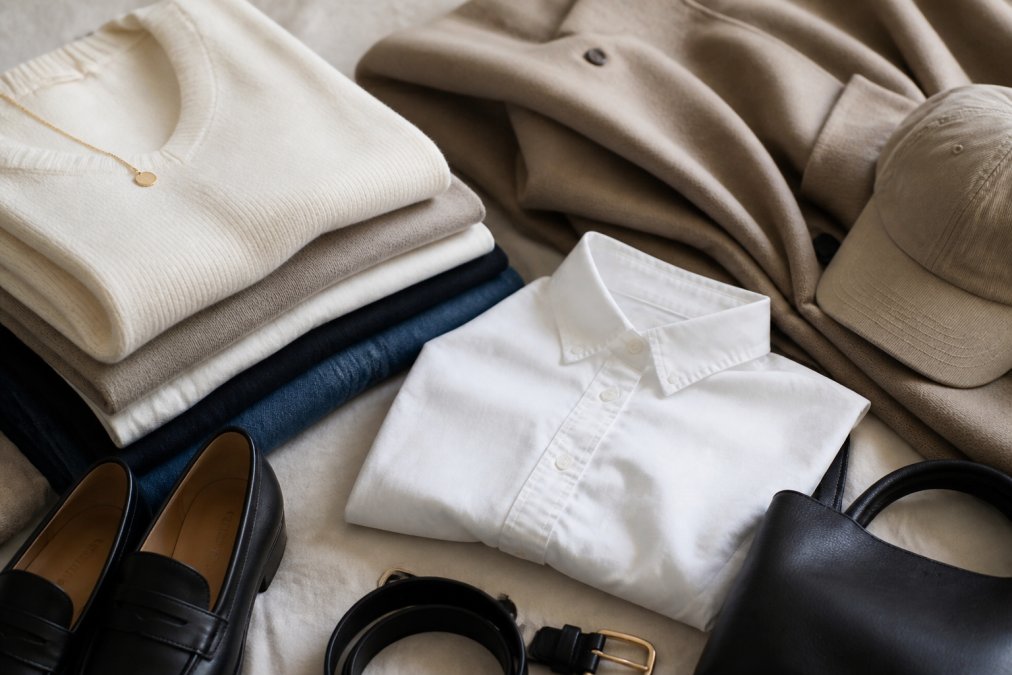
The 12 elevated basics fall into three groups: foundations worn against the skin, layers that add warmth and structure, and finishers that pull a look together. Own these and most outfits assemble themselves.
The Foundation: Tees, Knits, and Denim
Start with what touches your skin. A midweight cotton crew neck in a color that isn't black does more work than three graphic tees. Southe's Brown Cotton Crew Neck Tee ($59) and Maroon Cotton Crew Neck Tee ($59) are cut straight through the body so they skim rather than cling.
Denim is the second half of the foundation. Rigid denim holds its shape and softens over time, which is why the 2K Mid Rise Relaxed Baggy ($98) gets better with wear. The Nori Jeans ($95) take the opposite approach: wide leg, cuffed hem, 100% cotton with no stretch.
The Layers: Cardigans, Button-Downs, and Sweaters
Layers are where a wardrobe gains range. A button-down cardigan worn open over a tank reads casual; buttoned as a top with matching pants, it reads like tailoring. The Eloise Button Down Cardigan ($62) does both, in black or cream.
For a looser layer, the Sheer Sky Blue Relaxed Button-Down ($70) is light enough for a warm afternoon and soft enough to layer.
The Finishers: Trousers, Tanks, and Tailoring
Finishers decide whether an outfit looks assembled or accidental. The Eloise High Waisted Sweater Pants ($72) feel like loungewear and read like tailoring, and match the Eloise cardigan for a full knit set. The Linen Drawstring Pant ($138) is 100% linen sourced in California, garment washed to remove shrinkage, with a 31" inseam.
| Group | Pieces | Price Range | Wear It For |
|---|---|---|---|
| Foundation | Tees, knits, denim | $59-$98 | Everyday, weekends |
| Layers | Cardigan, button-down, sweater | $62-$88 | Office, travel, layering |
| Finishers | Trousers, tanks, tailoring | $68-$138 | Work, dinner, day-to-night |
How to Curate a Capsule Wardrobe That Fits Your Life
Learning how to curate a capsule wardrobe starts with your actual calendar, not a Pinterest board. Count how you spend a typical week, then buy for those days first.
- List your week by activity: office days, errands, dinners, travel.
- Assign a uniform to each: knit set, denim and a tee, trousers and a tank.
- Count how many of each you genuinely need.
- Fill gaps with pieces that cross categories.
- Cap the wardrobe at a number you can see at a glance.
Investment Pieces for Women Over 30: What's Worth the Money
Investment pieces for women over 30 are the ones you wear weekly for years, not the ones with the highest price tag. Price alone tells you nothing.
Cost-Per-Wear: The Math That Changes What You Buy
Cost-per-wear is the purchase price divided by the number of times you wear the item, the single most useful number in a wardrobe, and almost nobody runs it.
Run the math before you buy, not after:
Carlyle Everyday Crew Neck Sweater →
- Estimate wears per year, realistically.
- Multiply by the years you expect to keep it.
- Divide the price by that total.
- Compare against the alternative at the same threshold.
Fabric Quality and Care: Making Pieces Last
Fabric quality and care decide whether a piece lasts three seasons or ten, and most of the damage happens in your own laundry room. The fiber matters, but so does what you do to it.
Why Fiber Choice Determines Wear Life
Cotton is the workhorse. Midweight cotton holds shape better than thin cotton, which is why a $59 crew neck tee can outlast a cheaper three-pack: thicker yarn resists the fiber breakage that causes pilling and neckline stretch. Linen is stronger wet than dry, which is why garment-washed linen, like the Southe Linen Drawstring Pant, resists shrinkage and softens with each wash.
A Care Protocol by Fiber
Cotton (tees, denim, button-downs). Wash cold to reduce fiber stress. Skip the dryer for anything with a neckline you care about, heat stretches a crew neck out of shape. Turn denim inside out and wash it rarely, not weekly; spot-clean between washes.
The Rules That Apply to Everything
- Wash cotton and linen in cold water to reduce fiber stress.
- Skip the dryer for knits and linen; lay them flat instead.
- Turn denim inside out and wash it rarely, not weekly.
- Fold knits rather than hanging them, so shoulders do not stretch.
- Treat a stain the day it happens, not the week after.
- Use mesh bags for anything delicate or with hardware.
- Store clean, not dirty, moths and oils attract damage.
A common mistake is over-washing. Most pieces worn against skin need a wash after one or two wears, not every single one. Fewer wash cycles means less pilling, less fading, and a longer life for the pieces you paid more for. The second most common mistake is heat, almost every fiber here lasts longer when it never touches a hot dryer.
Styling Elevated Basics for Work and Weekends
Styling elevated basics for work and weekends comes down to one swap: change the finisher, keep the foundation. But the swap only works if the foundation fits your frame. Here is the version that accounts for body shape and a day that runs from a morning meeting to school pickup to dinner.
Fit First: What Each Body Shape Should Reach For
Fit is the biggest lever on whether a basic looks elevated or accidental. The same $59 crew neck tee reads intentional on one frame and sloppy on another, and it is almost never the tee's fault, it is the shoulder seam, the rise, and the hem length.
The Work-to-Weekend Swap, Outfit by Outfit
Once fit is dialed, the work-life transition is mechanical. Three formulas cover almost every day.
Day-to-Night Without an Outfit Change
The trick is texture, not accessories. A monochromatic base in black or cream, one piece with visible texture like rib knit or linen, and a single finisher that shifts the register. The rib tank under the cardigan goes from errands to dinner with just a change of shoe. One rule: the more texture in the base, the less you need to add later.
Frequently Asked Questions
What is the 3-3-3 rule for clothes?
The 3-3-3 rule is a packing and wardrobe framework: three tops, three bottoms, and three pairs of shoes that all work together. It creates nine outfit combinations from just nine items. For elevated basics for women over 30, the rule works as a starting filter. If a piece doesn't pair with at least three things you already own, it isn't a basic. It's a one-off.
Are elevated basics worth the investment?
It depends on cost-per-wear. A $98 pair of rigid denim jeans worn twice a week for two years costs about $0.94 per wear. A $30 pair that loses shape after three months costs more per wear and gets replaced sooner. Elevated basics are worth it when the fabric holds up, the fit is consistent, and you actually reach for the piece. Price alone doesn't make something an investment.
What does every 30-year-old woman need in her wardrobe?
At minimum: two pairs of well-fitting jeans, three to four quality tees in neutral tones, one knit sweater, one cardigan that works buttoned or open, one button-down, one pair of tailored trousers, and a rib tank for layering. These pieces form the foundation. From there, add pieces that reflect your actual routine, not an aspirational version of it.
How do you transition from trendy to timeless fashion in your 30s?
Start by auditing what you already wear most. Keep the pieces that get repeated wear and let go of anything that only worked for one season. Replace those gaps with classic silhouettes in a neutral palette: a crisp white shirt, a tailored blazer, straight or wide-leg denim. Trends can still be fun, but they become accents on a timeless base rather than the whole outfit.
How many pieces should a capsule wardrobe have?
Most capsule wardrobes run between 25 and 40 pieces, including shoes and outerwear. The exact number matters less than the ratio: every piece should pair with at least three others. Start with 12 elevated basics and build from there. If you find yourself never wearing something, that's your signal to remove it and refine.