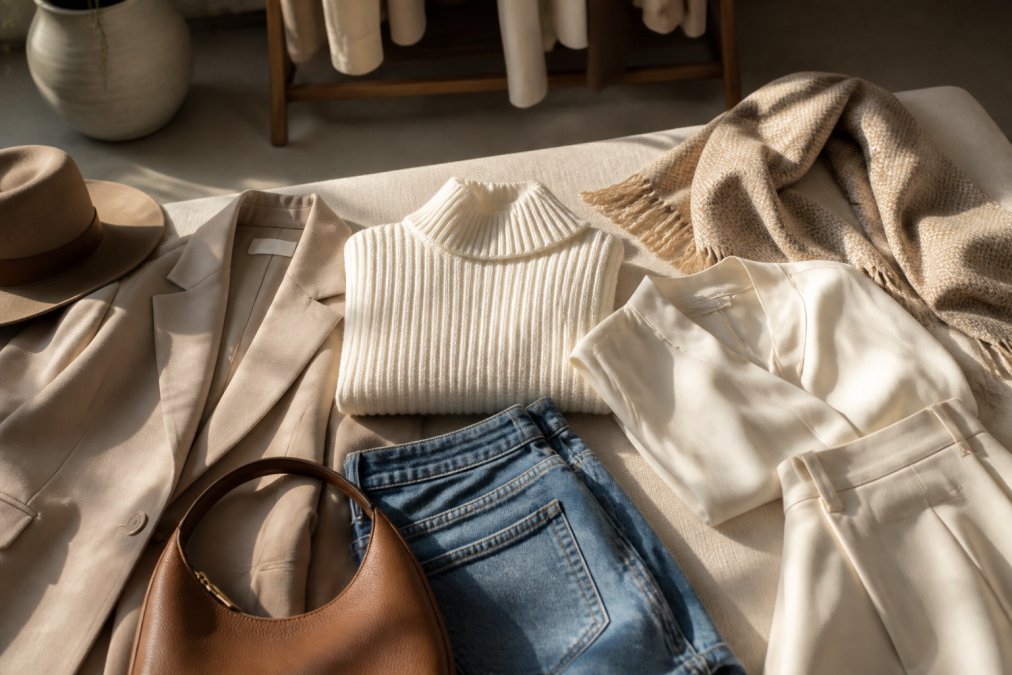
Article: How to Curate a Capsule Wardrobe: A 2026 Guide
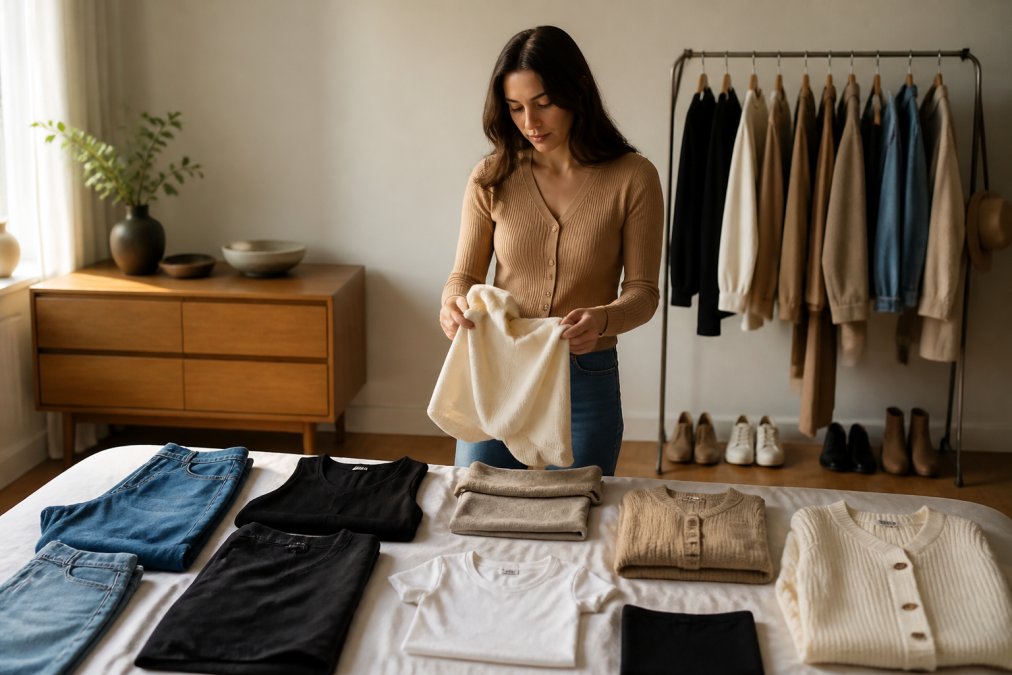
How to Curate a Capsule Wardrobe: A 2026 Guide
Table of Contents
- What Is a Capsule Wardrobe and Why It Works
- How to Declutter Your Closet: A Step-by-Step Approach
- Building Your Capsule Wardrobe Color Palette
- The Essential Capsule Wardrobe Checklist
- Modular Systems and Layering for Versatility
- Sustainable Care and Repair for Longevity
- Tailoring Your Capsule Wardrobe to Your Lifestyle
- Frequently Asked Questions
Last Updated: September 12, 2026
What Is a Capsule Wardrobe and Why It Works
A capsule wardrobe is a tightly edited collection of interchangeable pieces chosen for fit, fabric quality, and how well they work together rather than for novelty. It trades volume for versatility: fewer items, more outfits, less daily friction.
The appeal isn't minimalism for its own sake, it's decision fatigue. When every piece pairs with at least three others, getting dressed stops being a negotiation.
We see this constantly with clients building a wardrobe around elevated essentials rather than trend cycles. The pieces that earn their place are the ones you reach for without thinking.
How to Declutter Your Closet: A Step-by-Step Approach
Decluttering is the foundation of any capsule wardrobe, and where most people quit early. Treat it as an audit, not a purge.
- Empty the closet completely. Pull everything out so you can see the full inventory at once.
- Sort into three piles: keep, repair, release. Be honest about the repair pile; if it's been sitting for a year, it's a release.
- Apply the cost-per-wear test. Divide what you paid by how many times you've actually worn it. Low cost per wear earns a spot.
- Check condition. Stains, pilling, and stretched seams are reasons to let go, not reasons to hold on.
- Store off-season pieces. Seasonal rotation keeps the active closet focused.
- Photograph what remains. A visual inventory makes future shopping decisions easier.
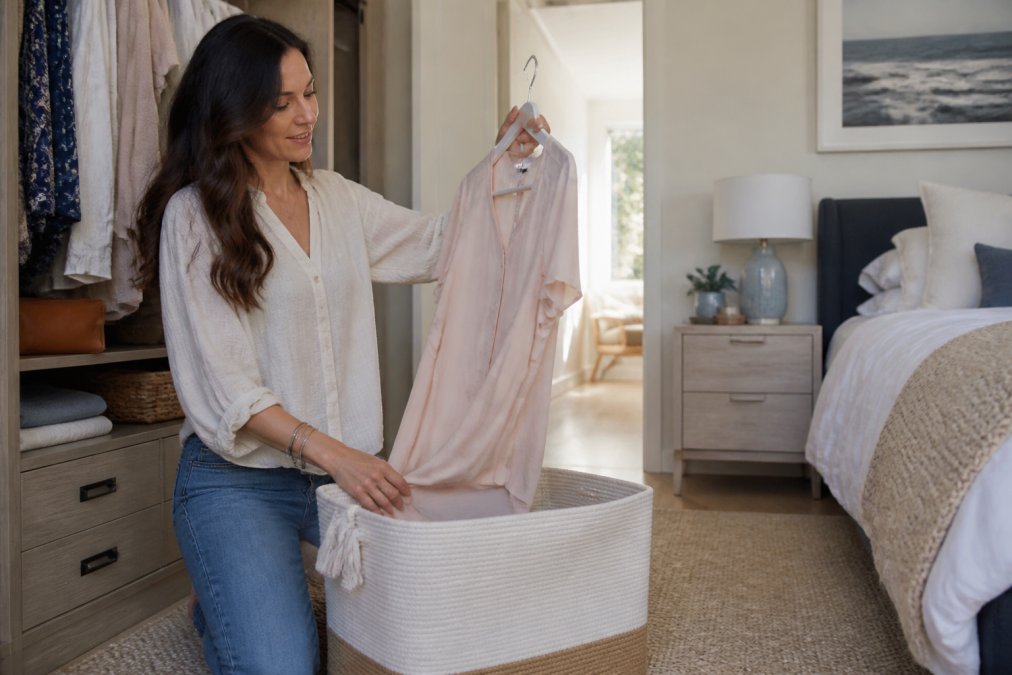
A common mistake is keeping items for a fantasy version of your life. If you haven't worn the sequined top in two years, the occasion isn't coming.
Building Your Capsule Wardrobe Color Palette
Your color palette is the backbone of a capsule wardrobe and should be narrow enough that everything matches without effort. Most workable palettes run on two neutrals, two accent tones, and one statement color.
Start with the neutrals you wear most: navy, cream, camel, grey, or black. Add accents that flatter your coloring and suit your climate. Neutrals do the heavy lifting; accents keep the palette from feeling flat.
Here's a simple framework:
| Palette Layer | Count | Examples | Purpose |
|---|---|---|---|
| Core neutrals | 2-3 | Navy, cream, camel | Base for every outfit |
| Secondary tones | 2 | Olive, soft grey | Adds depth |
| Accent color | 1 | Rust, coastal blue | Personal signature |
| Metallic | 1 | Gold or silver | Finishing detail |
Once the palette is set, mix and match becomes automatic. A camel knit works with navy trousers and a cream tee without a second thought.
The Essential Capsule Wardrobe Checklist
A working capsule wardrobe checklist covers roughly 25 to 35 pieces, depending on climate and how often you dress for work (goodhousekeeping.com). The count matters less than the categories.
- 2-3 tailored blazers or structured jackets
- 5 tops in core neutrals (tees, silk shells, fine knits)
- 3 button-down shirts or blouses
- 2 pairs of well-fitting trousers
- 1 pair of dark denim
- 1 midi or maxi skirt
- 1 little black dress or equivalent
- 1 lightweight knit cardigan
- 1 trench or transitional coat
- 1 pair of quality leather flats or loafers
- 1 pair of heeled sandals or boots
- 1 statement bag
Treat these as foundational items, not a rigid list, your personal aesthetic shapes the final edit.
Modular Systems and Layering for Versatility
A modular system treats your wardrobe like building blocks: base layer, mid layer, outerwear. Each module swaps without breaking the outfit.
The base layer sits against your skin (tees, camisoles, fine knits); the mid layer adds warmth and interest (cardigans, blazers, overshirts); outerwear handles weather and finishes the look.
Layering extends this further: a silk shell under a blazer under a trench creates three distinct outfits from the same three pieces, depending on what you remove. This is where versatility lives.
Sustainable Care and Repair for Longevity
Caring for your clothes is the least glamorous part of a capsule wardrobe and the one that determines whether it lasts. Most guides stop at "wash less, buy better." The real work is a maintenance routine built around four habits: washing, drying, repairing early, and storing with intention.
Wash less, and wash smarter
Most garments don't need a full wash after one wear. Airing a piece overnight on a padded hanger, somewhere with moving air, not a closed closet, resets it. Rotate two or three wears between washes for knits, trousers, and outerwear; wash tees and anything worn against the skin after each use.
When you do wash, follow the care label as a floor, not a ceiling. Cold water on a gentle cycle is the default for almost everything except heavily soiled workout gear and linens. Turn knits and prints inside out, close zippers, and use mesh bags for delicates and hardware that could snag. Skip fabric softener on technical fabrics, towels, and moisture-wicking pieces; it coats fibers and reduces performance. Use a mild detergent, a small amount of a pH-neutral formula often outperforms a large amount of a standard one.
Dry with intent
The dryer is the fastest way to shorten a garment's life: heat breaks down elastic, shrinks natural fibers, and pills knits. Air-dry whenever you can. Lay knits flat so they keep their shape; hanging a wet knit stretches the shoulders. Hang woven shirts and trousers by the hem or waistband. If you must use a dryer, choose the lowest heat and pull items out slightly damp.
Repair before you replace
A tailor is almost always cheaper than a replacement, and the fix is usually invisible (thespruce.com). Common repairs worth paying for:
- Rehemming a skirt or trouser that has lost its length or is dragging.
- Taking in or letting out a waistband after weight changes.
- Replacing a zipper on a jacket or dress, a $15-$40 job at most tailors versus the cost of a new piece.
- Reinforcing buttons and seams before they fail, not after.
- Darning small holes in knits and socks; a good darner can make the repair nearly disappear.
- Resoling and reheeling leather shoes. A cobbler can add years to a pair of loafers or boots for a fraction of replacement cost.
Learn two or three basic hand skills: sewing on a button, fixing a fallen hem with a blind stitch, and mending a small seam. A basic sewing kit, needles, thread in your core neutrals, small scissors, and a seam ripper, costs little and pays for itself the first time you use it.
Store with intention
How you store clothes determines whether they hold their shape and stay pest-free.
- Fold knits; hang wovens. Hanging a heavy sweater stretches the shoulders out of shape. Fold and stack on a shelf. Hang structured jackets, blazers, and button-downs on padded or wide hangers so the shoulder line is supported.
- Give clothes room. Overstuffing a closet crushes fabrics and creases everything. Leave a finger's width between hangers.
- Rotate seasonally. Store off-season pieces clean, stains set over time, in breathable cotton or canvas garment bags, not vacuum-sealed plastic, which traps moisture and can yellow natural fibers.
- Deter pests naturally. Cedar blocks, lavender sachets, and periodic airing keep moths and silverfish away without harsh chemicals. Refresh cedar by lightly sanding it once a year.
- Address stains immediately. Blot, don't rub. Cold water for protein stains (blood, dairy), warm for grease (cleaninginstitute.org). When in doubt, take it to a dry cleaner before the stain sets.
A capsule wardrobe is only as sustainable as the care routine behind it. The pieces you keep longest are the ones you maintain, not the ones you replace.
Tailoring Your Capsule Wardrobe to Your Lifestyle
One capsule does not fit every life. A remote worker needs different foundational items than someone client-facing, a coastal climate calls for different outerwear than a Midwest winter, and body type changes which silhouettes get worn. The generic 25-to-35-piece checklist is a starting point, not a prescription.
Build modules by work environment
Treat your capsule as a core set of pieces plus a work module that swaps in and out. The core, tees, denim, knits, a coat, shoes, stays constant. The work module changes with your environment.
Corporate or client-facing. Weight the module toward tailoring. A workable starting point:
- 2-3 structured blazers (one navy, one neutral, one statement)
- 3-4 button-downs or silk shells in core neutrals
- 2-3 tailored trousers or pencil skirts
- 1 sheath or wrap dress
- 1 pair of polished loafers or low heels
- 1 structured tote
Creative or casual. Prioritize texture, proportion, and layers over structure:
- 1-2 relaxed blazers or overshirts
- 3-4 fine knits and quality tees
- 2 pairs of denim (one dark, one lighter wash)
- 1 midi skirt or wide-leg trouser
- 1 pair of clean sneakers or ankle boots
- 1 crossbody bag
Remote or hybrid. Comfort is the constraint, but camera-ready matters. Build around soft structure:
- 2-3 fine-gauge knits and elevated tees
- 1 relaxed blazer or cardigan for video calls
- 2 pairs of pull-on or elastic-waist trousers that read as tailored
- 1 pair of comfortable flats or loafers for errands
- 1 versatile tote or backpack
Most practitioners find that a work module of 10-14 pieces is enough to cover a full week without repeats, especially when the core pieces layer underneath.
Adapt for climate, not just category
A coastal climate rewards breathable layers, linen, cotton, lightweight wool, and a water-resistant trench. A Midwest winter demands a heavy coat, insulated boots, and a layering system that traps warmth. With four distinct seasons, keep two capsules, warm- and cold-weather, and let core pieces (denim, tees, shoes) bridge them.
Tailor to your body type
The capsule concept is flexible; the checklist is not. What matters is proportion and where hems land.
- Petite. Favor vertical lines: monochrome outfits, high-rise waists, and hems that hit at the narrowest point of the leg or just above the ankle. Avoid oversized outerwear that swallows the frame; a cropped or hip-length jacket reads better than a long trench.
- Tall. Longer hems, extended lengths, and horizontal breaks (belts, tucked tops, layered knits) balance the silhouette. Maxi skirts and longline coats work in your favor.
- Curvy. Prioritize fabrics with a bit of stretch and structure that skims rather than clings. Wrap tops, A-line skirts, and high-rise trousers with a defined waist tend to earn their place. Fit the largest area first, then tailor the rest.
- Straight or athletic. Create curve with belted waists, tucked tops, and pieces that add volume at the hip or shoulder. Draped fabrics and soft tailoring work well.
- Apple or midsection-focused. Empire waists, open cardigans, and column dresses draw the eye vertically. Structured shoulders balance the frame.
A useful rule: buy to fit your largest measurement, then have the rest tailored. An alteration is often cheaper than replacing an item.
Name the psychology behind the purchase
Many people shop to fill an emotional gap rather than a wardrobe one, boredom, stress, a bad day, a sale. A capsule wardrobe makes that pattern visible, because every purchase must justify its place against a finite set. Before you buy, ask three questions:
- Does this fill a real gap in my modules, or duplicate something I own?
- Does it work with at least three pieces already in my closet?
- Would I still want it at full price, in a month, without the sale?
If any answer is no, the item is a want, not a need, fine, as long as you name it honestly. The goal isn't to never shop; it's to shop on purpose.
Frequently Asked Questions
What is the 3-3-3 rule for a capsule wardrobe?
The 3-3-3 rule is a simple framework: choose 3 tops, 3 bottoms, and 3 pairs of shoes that mix and match to create multiple outfits. This minimal starting point helps you test whether a capsule wardrobe approach fits your lifestyle before committing to a larger edit. Many people find that 9 well-chosen pieces yield over 20 outfit combinations, proving that versatility comes from thoughtful selection rather than volume.
What are the most common capsule wardrobe mistakes to avoid?
Common mistakes include buying too many trendy pieces that date quickly, ignoring your actual daily activities when selecting items, and choosing a color palette that doesn't suit your complexion. Another pitfall is keeping clothes that don't fit well because you plan to alter them later. A capsule wardrobe works best when every piece fits properly, suits your real life, and aligns with your personal aesthetic.
How many items should be in a functional capsule wardrobe?
There is no universal number, but most capsules range from 20 to 40 items, including shoes and outerwear. The right count depends on your climate, profession, and how often you do laundry. A good rule is to start with fewer items and add only when you notice a genuine gap. The goal is a wardrobe where you wear 90% of the pieces regularly, not a specific number.
What are the essential pieces for a year-round capsule wardrobe?
Year-round essentials typically include a crisp white shirt, dark jeans, a tailored blazer, a neutral cardigan, a little black dress, and versatile shoes like loafers or clean sneakers. Layering pieces such as a trench coat and a lightweight sweater help adapt to seasonal shifts. Choose fabrics that breathe in summer and layer well in winter, like cotton, linen, and merino wool.
How do you curate a capsule wardrobe for different age groups?
The principles remain the same, but priorities shift. Women in their 30s and 40s often balance work and social occasions, so they may need more structured pieces. Those over 50 might prioritize comfort and ease without sacrificing style. The key is to focus on quality over quantity, choose timeless silhouettes, and adjust the color palette to complement your skin tone and hair color.
What is the 5-4-3-2-1 capsule wardrobe method?
The 5-4-3-2-1 method is a packing or capsule formula: 5 tops, 4 bottoms, 3 dresses or outerwear pieces, 2 pairs of shoes, and 1 accessory. It is designed to create a compact, travel-friendly wardrobe that still offers variety. This method works well for a seasonal capsule or a weekend trip, and it forces you to focus on mix-and-match potential.
Building a capsule wardrobe takes an initial investment of time, and the payoff is a closet that actually works. Southe curates elevated essentials designed for exactly this approach, from foundational pieces to statement accents, all under $150 and selected for quality that holds up. Southe Circle members get first access to new collections and coastal-inspired styling guidance. Shop all at Southe and start building a wardrobe that earns its place.